 AcousticAcoustic
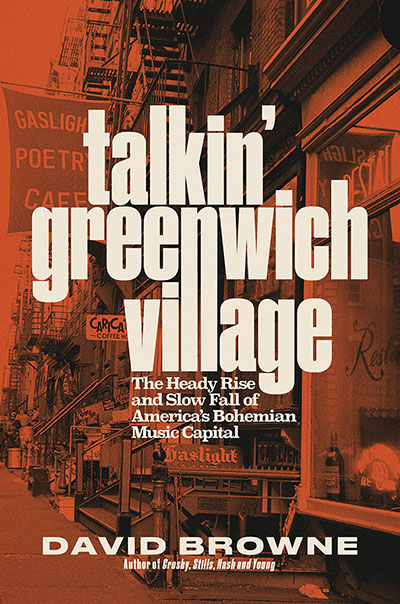
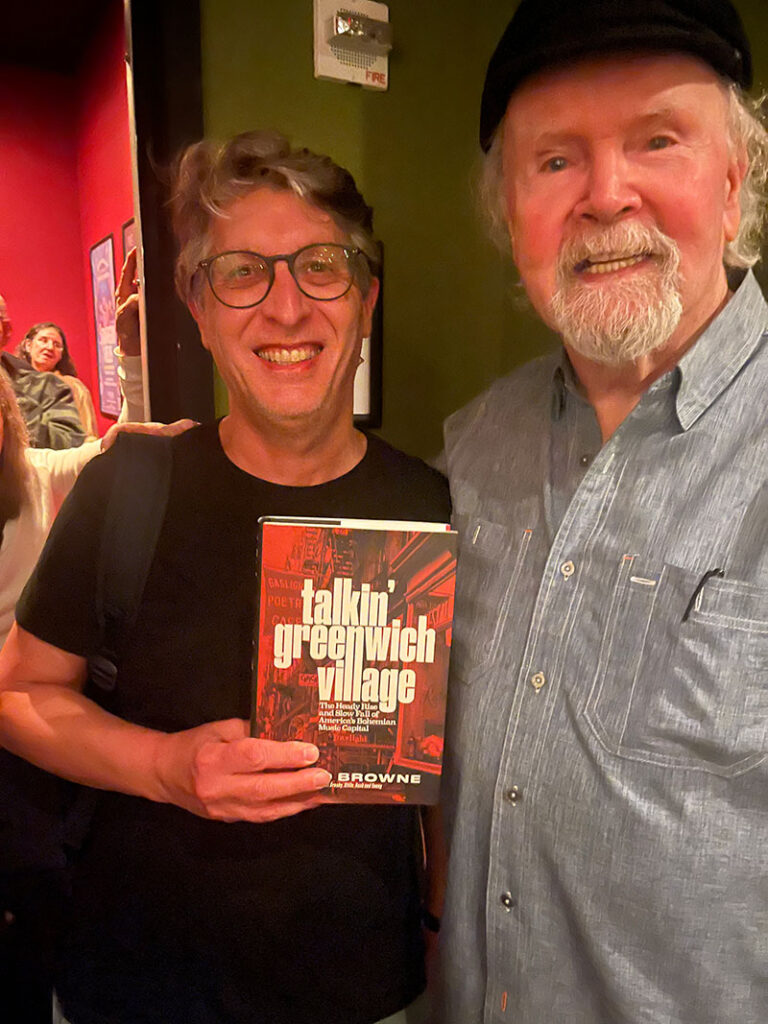
Music writer David Browne graduated from Greenwich Village-based NYU in 1982 and, obviously, spent a lot of time in the legendary Manhattan neighborhood. It didn’t dawn on him, though, until 38 years later while working at Rolling Stone, that no books had been written documenting the historic, groundbreaking jazz and folk music that emerged from Greenwich Village in the 1950s and 1960s.
“It felt like a scene that needed to be chronicled, since there hadn’t been a narrative history of it, which somewhat shocked me,” says Browne, who decided in 2020 to write Talkin’ Greenwich Village: The Heady Rise and Slow Fall of America’s Bohemian Music Capital. “Most of the clubs were gone, many of the veterans of the scene had passed away or were winding down, and it just felt right. I had no idea, when I began, that Timothee Chalamet would be portraying Dylan in a movie about that scene a few years later!”
Without Bob Dylan, who arrived in January 1961, would the 1960s Greenwich Village folk scene have been so universally celebrated? I ask Browne. Or would it have been a whimper in musical history?
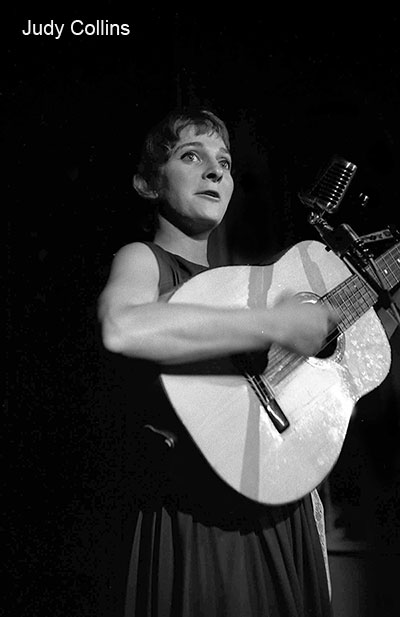
“That’s a great question,” he responds. “On one hand, there were so many talented singers and songwriters who arrived there either right before he did or just after—Judy Collins, Phil Ochs, Tom Paxton, Eric Andersen and so many more—that it’s hard to think they wouldn’t have gotten anywhere without Dylan. But the way in which Dylan became so mythic so quickly, and the way Peter, Paul and Mary’s version of ‘Blowin’ in the Wind’ gave the Village national name recognition, were certainly instrumental in catching the eyes of the public and the music biz.”
Besides the great music that emerged from the Village folk scene, I ask Browne, who has written eight books and is a Rolling Stone contributing writer, to sum up the ‘60s musicians’ effect and impact on political and social events during that time.
“Those songwriters, like Dylan, Ochs, Buffy Sainte-Marie and Tom Paxton, made it seem logical, even normal, to read an article in the paper or watch a segment on TV news, and then write a song about it,” he says. “They cemented the idea art could reflect and be impacted by the world around us, and in very concrete ways. Protest songs existed at least as far back as the Civil War, but those sixties troubadours reinvented the idea for a new generation, putting those songs on record and on the radio for anyone to hear.”
Folk and blues musician Dave Van Ronk influenced and sheltered Dylan when he settled in the Village, and, though an actor plays Dylan in the Chalamet movie, A Complete Unknown, Van Ronk’s name is not mentioned. Shouldn’t Van Ronk, who was nicknamed “The Mayor of MacDougal Street” and wrote a memoir with that title, been given more prominence in the movie?
“Van Ronk does appear in at least two scenes in A Complete Unknown, but you’re right—he’s not mentioned by name,” Browne responds. “Given his role, especially as a mentor to Dylan, he should have been identified. I get why so many others on that scene weren’t portrayed or mentioned; it was a dramatization, not a documentary. But Van Ronk’s role in the Village music world—as performer, guitar teacher, prematurely wise old soul, all the way through his death in 2002—could have been woven a little bit into the story. Maybe they felt Inside Llewyn Davis, based very loosely on his posthumous memoir, would suffice!”
Dylan’s presence and leap to stardom overshadowed the great talents of other Village songwriters and musicians. So, I ask Browne which Greenwich Village folk musicians never truly got their due.
“At the time, folks like Phil Ochs and Eric Andersen seemed on the verge of getting their dues,” he says. “Ochs headlined at Carnegie Hall a few times, and Andersen was on the Johnny Cash TV show. But neither ultimately broke through in a way commensurate with their art. Andersen took singer-songwriterdom to a new, more sensuous, almost erotic level, and Ochs, while known for his topical songs, made at least one album of more personal material, including 1969’s Rehearsals for Retirement. That’s the great lost album of the sixties. In the later days, the Roches, despite a wave of acclaim for their 1979 debut album, have never fully been given props for their smart songwriting and multi-layered, and quite astounding, harmonies. When you think of it, the list of Village musicians who did receive their due is so much smaller than those who didn’t.”
Following the footsteps of the 1960s Village folk musicians, Jack Hardy, with the help of Van Ronk and others, founded Fast Folk in 1982, a record label and music magazine that put the spotlight on a new crop of Village folk musicians. I ask Browne to compare the Fast Folk Movement to its predecessor.
“For starters, I viewed it up close and personal,” Browne responds. “I was starting my senior year at NYU and pitching ideas for a magazine-writing class, when I sensed something was happening in the clubs just a few blocks away from the main NYU campus. Before long, I was hanging out at Folk City and a falafel restaurant-turned-folk-club called the Speakeasy. The scene didn’t have the large-scale national impact that the sixties one did, and the songs were largely more personal than political, reflecting the shift in pop since the sixties.
“But it was pretty clear,” he continues, “that the singers and songwriters there—who came to include Shawn Colvin, Suzanne Vega and more—saw themselves as inheritors of a tradition. Some of the songs that emerged—certainly Vega’s ‘Tom’s Diner’—became new Village standards. The Fast Folk albums—those monthly DIY collection of new songs from many artists—were almost punk in their indie way. It’s a shame that so few songs from that scene were hits in the old-fashioned manner, but those were the years of new wave, no wave and early hip-hop. Folk was extremely unfashionable, and the scene paid a price for that. About 20 years ago, Smithsonian Folkways put together a compilation of the best of Fast Folk, which is another testament to its legacy.”
I ask Browne to name the best concert he attended that was performed by a musician from the Greenwich Village folk scene. He mentions four shows.
“For my first concert, my parents and I had second-row seats at Carnegie Hall in 1973 for Paul Simon, who was briefly a Village type with Art Garfunkel when they relaunched as a folk duo circa 1963. He played Simon & Garfunkel songs, as well as some from his first two albums, with the South American group Urubamba and the Jessy Dixon Singers backing him up. It was magical.”
Another “best” concert was Suzanne Vega at the Speakeasy on MacDougal Street in 1984.
“She played her updated repertoire of the time, just as she was about to record her first album,” he says. “So, it was the first time I heard songs like ‘Small Blue Thing’ and ‘Marlene on the Wall.’ It was a great intimate performance in a small space.”
Two veteran songwriters—85-year-old Dylan and Loudon Wainwright III, who becomes an octogenarian in September—are still touring and are on Browne’s “best” concert list.
“Loudon Wainwright III, one of the late sixties additions to the Village scene, is someone I’ve seen many times,” Browne says. “But a 1981 show at the Bottom Line, where he played songs from his soon-to-be-released Fame and Wealth, was a highlight. He seemed more on than usual. At the theater next to Madison Square Garden in 1997, Dylan, with opening act Van Morrison, had just recovered from his heart issue and seemed especially animated, almost happy to be there. With Larry Campbell and others backing him, he did a tremendous ‘Tangled Up in the Blue’ and others.”
Dylan’s controversial transformation from Village folkie to electric rock and roller at the 1965 Newport Folk Festival has always been a defining moment in rock and roll history. In Greenwich Village, however, folk musicians had gone electric six months before the historic Newport concert, Browne learned while researching Talkin’ Greenwich Village.
“Bands like the Lovin’ Spoonful and the Blues Project were already making that transition from acoustic to electric,” he says.
Browne’s research also led to various other surprising discoveries.
“I learned more about the making of ‘Blowin’ in the Wind’ and a Black female Village folksinger’s (Delores C. Dixon’s) role in its creation,” he says. “I learned about the details of the 1961 ‘folk riot’ in Washington Square Park; what the Roches had to contend with when they took their modern-Village act on the road and were booed by Boz Scaggs fans; how Danny Kalb of the Blues Project auditioned for but passed on being in the Blues Brothers, and John Sebastian sold weed early in his career to support himself!”
Other books by David Browne:
Crosby, Stills, Nash and Young: The Wild, Definitive Saga of Rock’s Greatest Supergroup (2019)
So Many Roads: The Life and Times of the Grateful Dead (2015)
Fire and Rain: The Beatles, Simon & Garfunkel, James Taylor, CSNY, and the Lost Story of 1970 (2011)
Dream Brother: The Lives and Music of Jeff and Tim Buckley (2001)
Goodbye 20th Century: A Biography of Sonic Youth (2008)
Amped: How Big Air, Big Dollars, and a New Generation Took Sports to the Extreme (2004)
The Spirit of ’76: From Politics to Technology, the Year America Went Rock & Roll (2014)
Jeff Buckley: His Own Voice (coedited with Mary Guibert) (2019)