
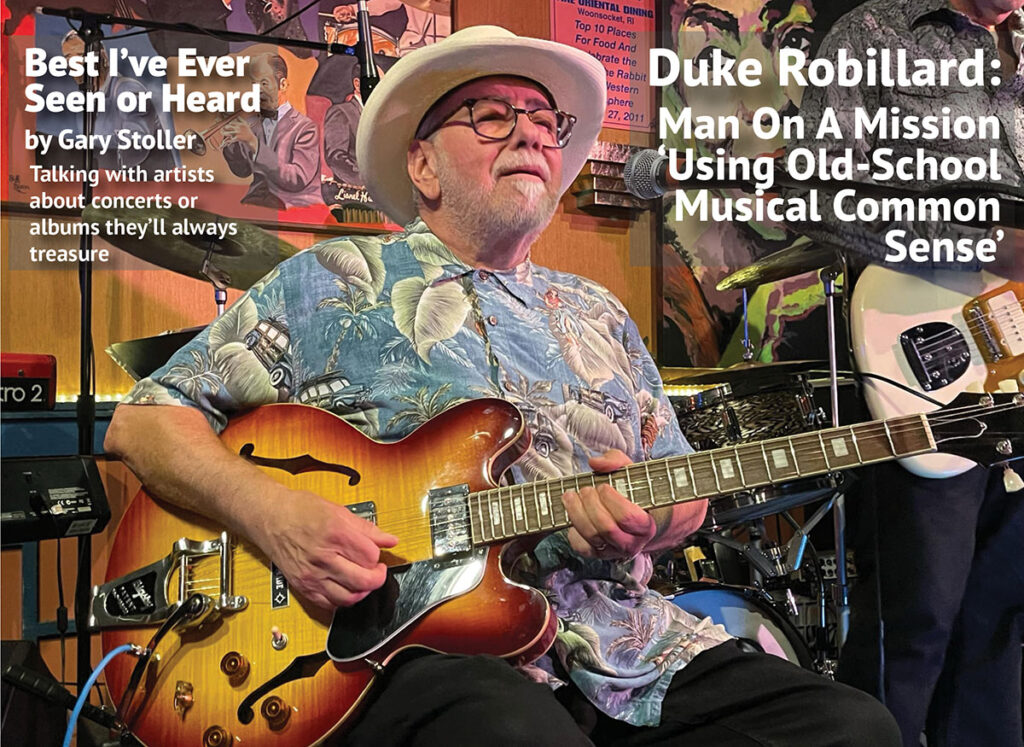
Duke Robillard has always been on a mission while mastering many genres—blues, jump R&B, swing and roots rock—throughout his long career as a guitarist, singer and songwriter.
“My entire life I’ve made it my mission to investigate the beginnings of all the styles of music I love,” says Robillard, who released his 38th album, Blast Off! in February. “I feel the need to thoroughly research the history of each style and understand where it came from.”.
When founding Roomful of Blues with pianist Al Copley in Westerly, Rhode Island, in 1967, Robillard explored swing and early R&B guitar styles, using a 1940s acoustic archtop guitar with an attachable DeArmond guitar mic.
“I played a non-cutaway guitar, so I would have every setback a guitarist from the mid-’40s would have, including heavy strings,” he explains. “I wanted authenticity of each period, so my playing only let in the exact style of each decade. After a while, it didn’t matter what guitar I played. I could nail the guitar style and tone of each genre’s style. So, I have been going back and forth between each style now for a very long time.”
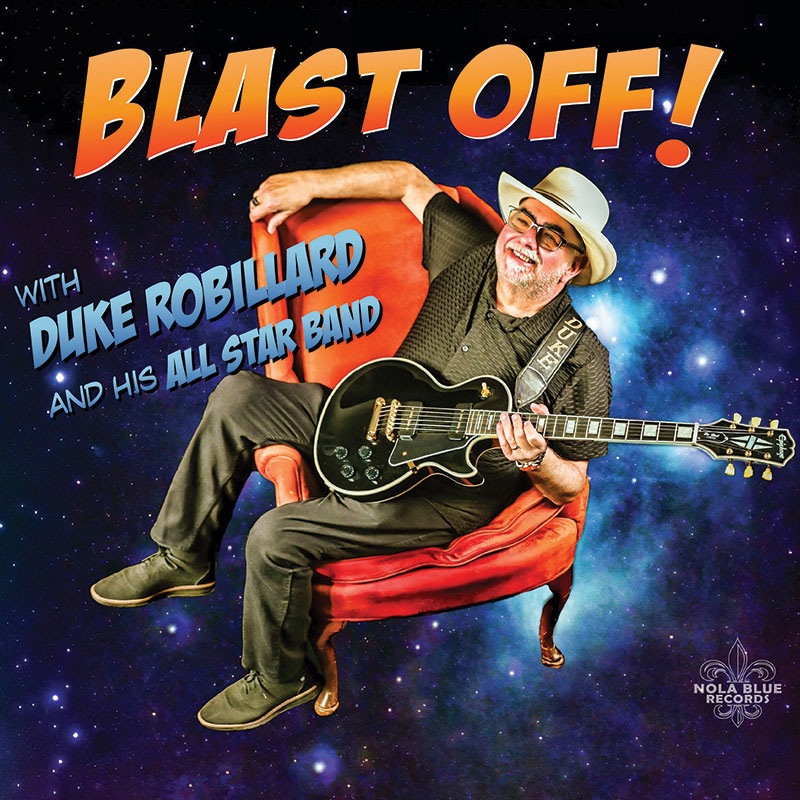
Many of his favorite styles are on display on Blast Off!, a tasty 12-song CD with three original songs and covers that include songs by Tom Waits, Allen Toussaint, Floyd Dixon, Eddie Jones, Count Basie and Jon Hendricks.
A crack “all-star band” plays with Robillard, including three longtime “musical cohorts”— keyboardist Bruce Bears, bassist Marty Ballou and drummer Mark Teixiera. On saxophone are Mark Earley and Doug James, a former member of Roomful of Blues. The lead vocalist is second guitarist Chris Cote, who also duets with Robillard on “I’ll Be Glad When You’re Dead (You Rascal You),” a song popularized by Louis Armstrong.
In the liner notes, Robillard cites his influences and the styles of music he loves.

“Mid-’40s to mid-’50s rhythm and blues is kind of my favorite thing,” he writes. “I guess I could say that they’re all my favorites—early rock and roll, early R&B, swing-era jazz, ‘20s jazz, ‘30s jazz. I love it all!”
But what do you love most about this album? I ask Robillard. How does it fit into your extensive catalog, and what is unique about it?
“I am very happy with the results of this album,” he responds. “Many of my albums cover a wide variety of styles, but I think this one may be closest to accomplishing the goal of touching on most of what I do in a totally successful way. Performance-wise, sound-wise and feel-wise.”
Robillard’s three original songs are “Feel My Cares,” “Blast Off!” and “Galactic Grease.”
The genesis of “Feel My Cares” goes back 60 years.
“At 17 years old, I studied all the blues greats and analyzed songs, trying to figure out how to write my own blues songs,” Robillard explains. “There is a line in a Robert Johnson tune: ‘I ain’t got no lovin’ sweet woman to love and feel my cares.’ I really liked that line and ‘feel my cares’ stuck with me, so I made a tune from it. I had no way to know I would record it 60 years later! I always kept the lyrics thinking someday I may use them. Better late than never.”
“Blast Off!” and “Galactic Grease” resulted from jamming with Ballou and Teixeira without the rest of the band.
“I laid down a simple rhythm guitar track while jamming and later figured out a melody,” Robillard says. “The results were fun and interesting!”
Why cover a way-out-there Tom Waits song, “Lowdown?” I ask. The song, with Waits’s vocals akin to, maybe, chalk scraping on a blackboard, doesn’t seem a fit with Robillard’s preferred styles.
“Although I had the 3-CD Orphans, which included ‘Lowdown,’ I never paid attention to ‘Lowdown’ until a friend sent it to me and suggested I record it. After reading the lyrics, I realized it was a perfect rock and roll tune for us. We did one rehearsal run through and then cut it in one take.”
All song selections on Blast Off! “revolved around making a diverse album that flowed like an eclectic mix of great tunes with a top-notch band that featured the band’s special talent,” Robillard says. “I feel I really accomplished my goal on this one!”
Besides the 38 albums released under Robillard’s name, he released joint albums with Herb Ellis and Ronnie Earl. He also played on numerous other artists’ recordings, including Bob Dylan, Jay McShann, Rosco Gordon, Jimmy Witherspoon and John Hammond.
Robillard played guitar on three songs on Dylan’s 2007 Time Out of Mind album: “Million Miles,” Tryin’ to Get to Heaven’ and “Can’t Wait.”
“They had started the Time Out of Mind sessions, and Bob decided he wanted me on the sessions,” Robillard says. “I had been asked for years to audition for his band but always turned it down. So, on a day’s notice, I flew to Miami and started the next day for nine days and nights of tracking live. There were 12 musicians, I believe, all playing at the same time very minimally. It was a uniquely interesting experience!”
Six years later, on April 6, 2013, I sat front-row center at Dylan’s concert at the University of Massachusetts’ basketball and hockey arena in Amherst and was excited to see Robillard as the lead guitarist. Although it was a decent Dylan performance, I left somewhat disappointed, because Dylan didn’t let Robillard solo and pretty much buried the lead guitar.
Soon after, Robillard exited the band mid-tour after three months of shows. I asked him years ago what happened, and he said he was saving his comments for a future book. But I asked him again during this interview, and he provided some details.
“Well, I had some great nights on that tour, and Bob expressed his gratitude often,” Robillard says. “But we took a break after the first leg, and when we came back to start up again, Bob was, all of a sudden, rude and unhappy with seemingly everything about me. After three days of that, it was time to say, ‘See ya!’ I was 65 and in no frame of mind for childish bullshit.”
Sony Music Entertainment, which owns Dylan’s entire back catalog of recorded music and rights to multiple future new releases, did not return emails, and spokesmen for Dylan did not comment.
Robillard’s departure pales in comparison to him leaving Roomful of Blues in 1979 after founding and playing in the band for 12 years.
“Well, now, that’s a deep one,” he says. “After we lost our deal with Island Records, we were at our wit’s end. I had been writing more and more my last couple of years with the band. I wanted to get these tunes recorded as they were written for the instrumentation we had. A few of the guys seemed resentful of my growing repertoire, and it was not looking especially encouraging as far as finding a new label.”
Robillard then received an offer to join Robert Gordon’s band as lead guitarist.
“It was a way for me to make a change and figure what my next move would be,” he recalls. “With Robert, we ended up not working very much, and I, being used to working six or seven nights a week, decided to start fresh with a trio to put my guitar playing in front. Roomful, at that point, added four new members, and the rest is history. It went well for all concerned, and a version of Roomful still exists today. The founding members who are still with us occasionally play as The Founders.”
Robillard points to a legendary blues master to pinpoint the best concerts he has witnessed. They occurred after he replaced Jimmie Vaughan as the lead guitarist for the Fabulous Thunderbirds in 1990.
“We toured with B.B. King in 1991 on his summer tour with Buddy Guy and Dr. John, and there were a few nights when BB was extra into it,” Robillard recalls. “I can say they were the best, or among the absolute best, blues performances I have ever seen, and I’ve seen a few!”
Concerts that influenced him most as a musician included those he performed with Muddy Waters, Big Joe Turner, Jay McShann and Lowell Fulson.
“I was sure what I wanted to do but not sure about my ability,” Robillard says. “Things that Muddy, Joe Turner, Jimmy Witherspoon and Johnny Shines said to me gave me the confidence to continue and know I had the goods.”
Robillard says it’s impossible to name an all-time favorite guitarist.
“But I guess I could say T-Bone Walker,” he adds, “because he invented electric blues guitar!”
Robillard hasn’t found a lot of contemporary music that interests him but says he is always open to finding new sounds and styles. He listens on the internet and appreciates “young players in the blues and jump style,” including McKinnley James. James’s debut album Working Class Blues, according to his website, “breathes new life into classic sounds” with a mix of “American rock & roll, amplified soul and raw rhythm & blues.”
What album is the best one Robillard has ever listened to?
“Any B+W (Black and White Records), Capitol or Imperial T-Bone Walker album,” Robillard answers. “Also, Count Basie Swings, Joe Williams Sings, Duke Ellington at His Very Best, Lester Young’s Master Takes/Savoy Recordings and Kenny Burrell’s ‘Chitlins con Carne’ (the opening track on his 1963 album Midnight Blue).
Those albums are packed with tasty cuts, and I mention to Robillard that “tasty” always comes to my mind when I hear his records or see him perform his songs live.
“For me, it all comes down to what I’ve listened to for the past 50 or 60 years,” he responds. “Having collected music on vinyl, 78 rpm records, 45s and CDs since the ‘50s, I constantly find new music among the recordings I have owned forever. So, the music I have spent my life listening to is where the ‘tasty’ came from, I guess. Just old-school musical common sense.”