
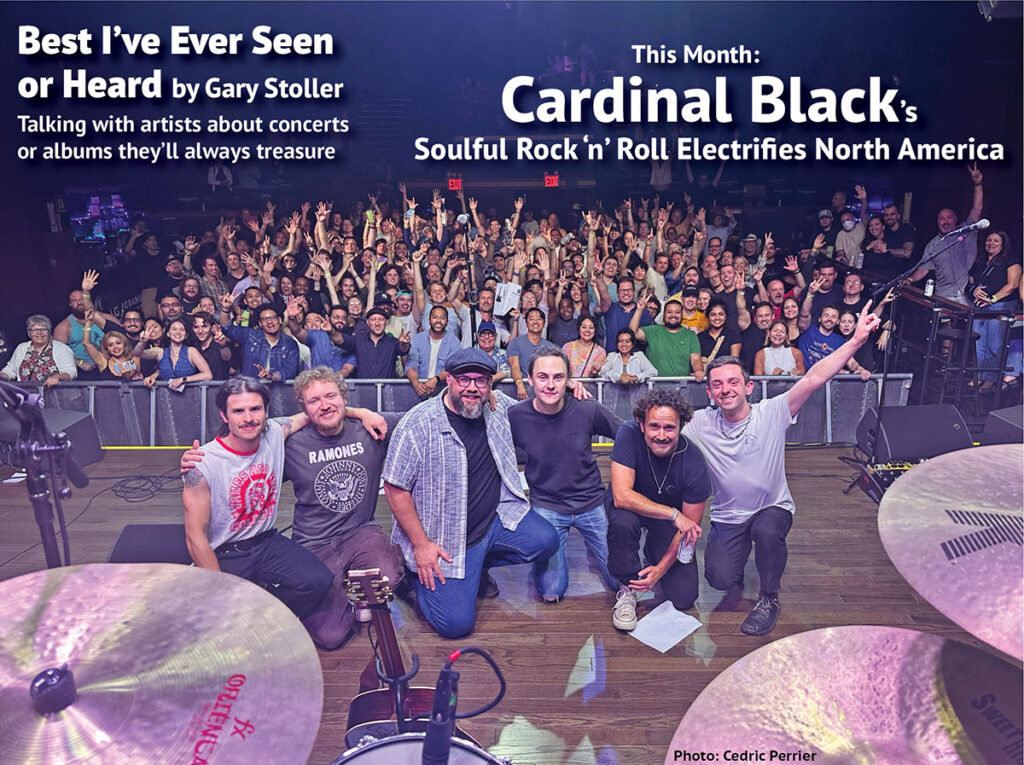
Every x amount of years a concert comes along that blows the mind and makes one want to shout about it to the world. I’ve had such an epiphany with classic shows, including Bob Dylan in a New Haven, Connecticut, club; Damien Rice with Lisa Hannigan in Manhattan, and Pink Floyd in Yankee Stadium. And then Cardinal Black came from Wales in August to play its first performance in New York City, and another incredible show sent me into orbit.
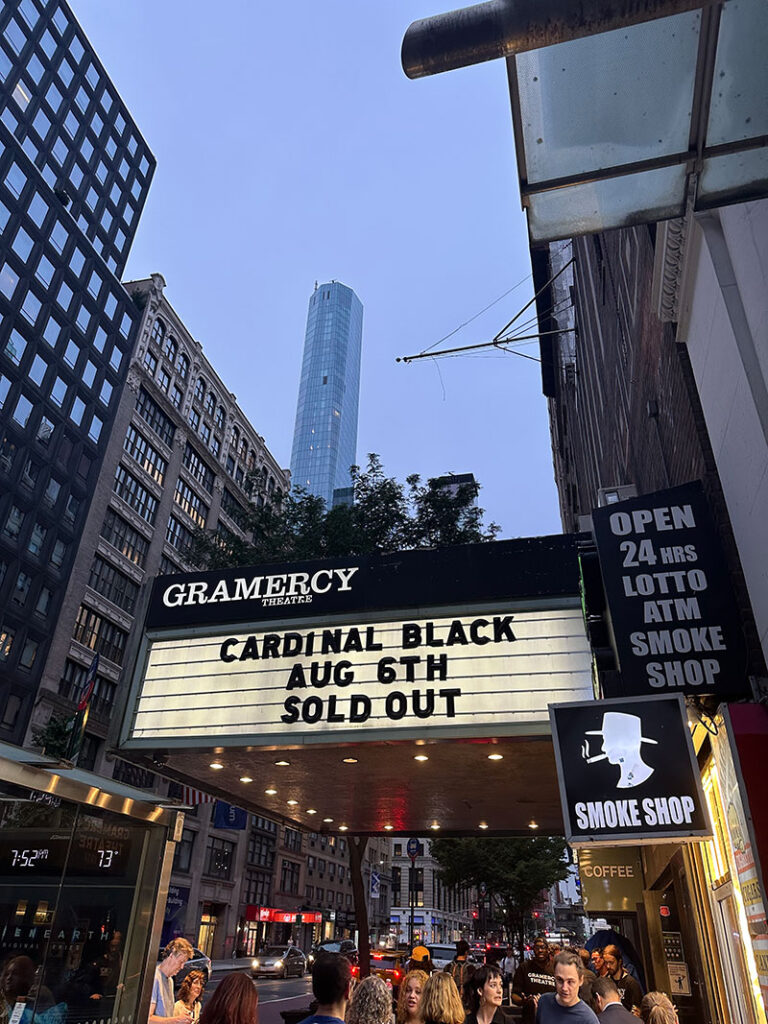
I knew nothing about the band or any of their songs when Cardinal Black took the stage at a sold-out Gramercy Theatre on Manhattan’s 23rd Street. The first three songs were good, but I didn’t understand what the buzz and the gushing about the band was all about. Then, for the rest of the show, the band had me stomping my rock and roll feet and gave me a euphoric chill and a memory I will never forget.
Cardinal Black rocks with the best of them. But what makes the guitar-based group extra special is the undercurrent of white soul and blues, the electrifying lead guitar work and the authoritative drumming. Plus, throughout the set, I heard sprinkles of Led Zeppelin, a frenzied CSNY electric jam, even Pink Floyd spaciness and who-knows-what-else. The band flew high, thrilled to be playing for the first time before an adoring Big Apple throng. And they repeatedly let the crowd know their appreciation for the big-city welcome.
Lead singer Tom Hollister evokes memories of Eddie Hinton and his brilliant Muscle Shoals-based white soul. Or is it the pioneering ‘60s white soul of Felix Cavaliere and the Rascals?
Drummer Adam Roberts, a close friend of Hollister who previously played in other Welsh bands with him, rules the backbeat with precision, forcefulness and grace. Roberts, a massive Led Zeppelin and Queen fan, calls Otis Redding his favorite singer and is another compass toward the band’s Southern soul vibe.
And maybe this should have been the lead to this review: Lead guitarist Chris Buck is the best, the most exciting and the most beautiful guitar player I have ever seen live — except for the immortal Jeff Beck. Buck bends and crafts notes and sounds that wow and wow and wow. One can only drool for his next solo to begin. But he also knows not to overwhelm songs and use his guitar for such special accents. Adding to his axe-slinging prowess is a good backup voice that often contributes and makes songs fuller and more interesting.
“I fell head over heels in love with New York,” Buck tells me as Cardinal Black drives out of New York to Toronto, the next stop on the band’s North American tour. “Admittedly, a truly memorable sold-out show at the Gramercy Theatre probably predisposed me to like the place a little more, but there’s something so impactful about rounding a corner and being confronted with buildings and places that you’ve only ever seen in films. It’s truly iconic and awe-inspiring. I’m looking forward to going back when we have a little more time to actually soak in the city and not run around collecting backline (musical equipment) and rental vehicles! First dates of a tour are always a little hectic, unfortunately, and it’s a shame the New York date fell in a city that I’m so desperate to see.”
During the past 15 years or so, Buck built up a huge online following because of his sensational guitar playing in YouTube videos. Buck, Hollister and Roberts played together in the Tom Hollister Trio more than 15 years ago, but Buck moved on to other musical ventures until the trio decided to give Cardinal Black a go just before the COVID epidemic. Besides the great music and songs they put together, Buck’s YouTube following led to many sold-out shows in the United Kingdom after the epidemic and this year’s U.S. tour.
“Officially, Cardinal Black started in 2021, but we’re the first to admit that’s a little misleading,” Buck explains. “Myself, Tom and Adam have a long, shared history of making music together, both original and as a function band where we did near a decade of celebrating any occasion or religion for the right price. The idea of getting the band back together had been floated a few times over the years, but ironically, it was COVID that finally gave us that final push we needed. What started off as a few sessions intended to rework older material very quickly turned into new songs, so, by the time restrictions were lifted and we were able to actually launch the band, there was none of the ‘big things coming soon’ preamble that you inevitably have with a new band. We were ready to hit the road!”
I ask Buck to describe Cardinal Black’s music and whether the band is guided by an overall musical aim.
“I don’t know whether we necessarily have a pre-agreed musical aim so much as being guided by trying to make music that we’d want to listen to ourselves,” he responds. “At which point, you have to hope you have half-decent taste! There are some fairly diverse influences between the three of us, but, ultimately, we’re all fans of great songs. As long as the musical choices we’re making have the song at its heart, we’re all on the same page. I guess, principally, we’re a rock band, but there’s elements of soul, Americana and blues thrown in as well.”
This year’s North American tour was quite significant in the history of the band.
“For a band making music that draws so heavily on American influences, the U.S, in particular, has always held a huge allure,” Buck says. “That said, if the crowds we played to last summer in Nashville and Los Angeles hadn’t been so incredibly receptive to our music, we would never have entertained the idea of a fully-fledged tour! And as much as particular shows and cities may prove to be highlights, I think I speak for all of us when I say that it’s the notion of a North American tour in its entirety that’s most exhilarating. The thought that there are enough people spread across North America to necessitate a tour is as surreal as it is exciting!”
I ask Buck about other Welsh musicians who have made their mark worldwide.
“Given its size or lack thereof, Wales has produced a fair amount of notable musicians, probably most notably Tom Jones and Shirley Bassey,” Buck answers. “But growing up in the ‘90s and early 2000s, the two bands that were of particular influence, not just for their musicality but also their nationality, were the Stereophonics and the Manic Street Preachers. Both, like us, are from South Wales. Watching them become so successful on a global scale was incredibly inspiring. Generally speaking, the South Wales Valleys are small, working class, tight-knit communities. So, the idea that something you wrote and rehearsed in your local rugby club could take you to stages on the other side of the world really helped drive us forward to make music.”
Slash from Guns N’ Roses is the only musician Buck has idolized.
“Growing up, trying to find my feet and identity as a person and musician, I really connected with Slash’s larger-than-life persona on stage and how quiet and softly spoken he was off it,” Buck explains. “I was quite a shy kid who didn’t particularly crave the spotlight. So, seeing someone like Slash, who wasn’t naturally extroverted or gregarious but could stand on top of a grand piano to rip a guitar solo in the ‘November Rain’ video, gave me a confidence that I could pull something similar off. I liked the idea that you could have that duality and separate those two characters. It didn’t hurt that he’s an incredible guitar player!”
Steve Winwood attended the first Tom Hollister Trio show in England in 2009 and was so impressed that he offered the band the use of his private studio in the Cotswolds.
“My father was a big Steve Winwood fan, so I was extremely familiar with his music from a really early age, from the Spencer Davis Group through to his solo career,” Buck says. “Seeing him front and center in the crowd at, literally, our first ever gig back in 2009 was surreal more than anything -— some fever dream come to life! He’d just come back from playing Madison Square Garden with Eric Clapton, so, more than anything, we were just a bit baffled why he was now in a pub in Cheltenham!”
Buck can’t recall the specific words Winwood said to the band, because it happened many years ago.
“But I remember being struck by his generosity, taking the time to give advice to a band that had just played their first-ever show and offering the use of his incredible studio in the Cotswolds with his engineer James Towler,” Buck says. “He’s a genuinely lovely guy and incredibly encouraging of new music.”
I ask Buck what was the best concert he attended by any artist and why it was the best.
“I went to see Duff McKagan from Guns N’ Roses with his solo band Loaded at the O2 Academy in Bristol in 2009,” Buck responds. “As well as bumping into him outside the venue that afternoon and having my photo taken, I couldn’t quite fathom that I stood about three feet from one of my musical heroes in a venue the size of a small bar with about 150 other people, watching him play Guns N’ Roses songs that I’d only seen played in stadiums on DVDs. It genuinely blew my mind and left an indelible impression as to the power of music and the importance of playing live. It was a hugely inspiring gig, and I’ve been lucky enough to have the chance to tell him since.”
Buck says it’s impossible to name the best album he ever listened to, but a few albums come to mind.
“Unsurprisingly, Guns N’ Roses Appetite for Destruction would be up there in terms of records that fundamentally helped shape the direction my life would take,” he says. “But, more recently, I’d say Hozier’s first, self-titled album. I’d never heard anyone combine so many of the musical elements, sounds and textures that I love into such a defined yet accessible sound that seems so simple but really isn’t. He also has such an effortless — caustic, if required — turn
of phrase that leaves you wondering: ‘How did I not think of that line?’ It’s uncanny.”
I ask Buck the differences between Cardinal Black’s debut full-length album, 2022’s January Came Close and this year’s Midnight at the Valencia.
“Our first record was an unusual one in the sense that, at the time of recording, some of the songs were a few weeks old, and some were 12 years old,” he replies. “We’ve joked previously that it felt like a greatest hits record of songs that nobody knew, and, consequently, I don’t think it was ever going to feel like a particularly cohesive record. For better or worse, it sounded like a record that had been written over the course of a decade. Comparatively, the second record was written in a few months, and, as much as I initially found that daunting, it actually ended up extremely liberating to create something from scratch that’s consistently representative of a particular point in time in all of our lives.
“On a more literal, sonic level, it’s a much better-sounding album than the first,” Buck adds. “We had virtually no budget with January Came Close, so it was recorded with the help of a few mates and favors called in. But Midnight at The Valencia was recorded in a beautiful studio called Powerplay just outside Zurich, Switzerland, with virtually no expense spared. We knew that if we wanted to try and break through to the next level, whatever that may look like, we had to raise our level in terms of the caliber of songwriting and the sound of the record. I’m extremely proud of it.”
What are Cardinal Black’s future recording plans?
“We’ll have to see what the rest of 2025 has in store for us, as that’ll dictate next year’s plans,” Buck responds. “But Midnight at the Valencia is still just months old, so we’re keen to make sure it reaches as many people as possible. I think it’s indicative of the lifespan of an album becoming increasingly short that we often find ourselves asking ‘what’s next?’ when we’ve only just released the last record! It can be a bit demoralizing, but, if nothing else, it lights a fire to keep progressing and keep creating.”