
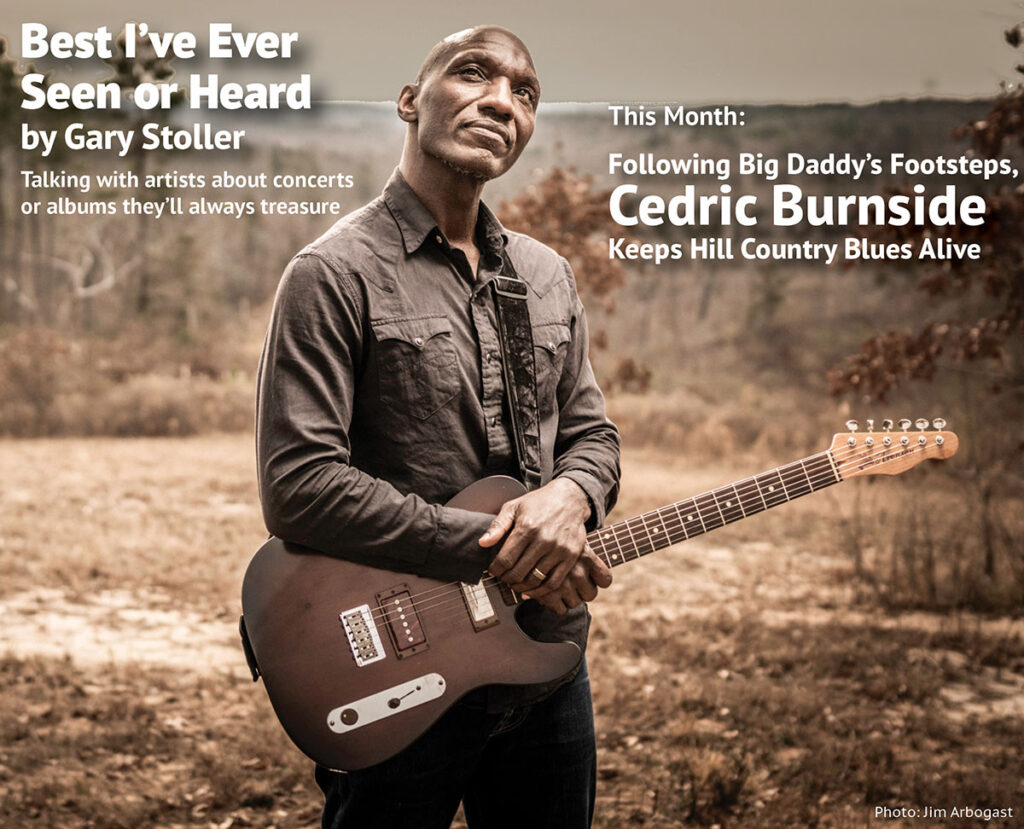
Many people automatically think of Texas when someone mentions the Hill Country. But musicians such as Cedric Burnside think first of Mississippi’s Hill Country, the home to its own genre of blues.
Burnside’s new album, Hill Country Love, delves into the raw, repetitive rhythms that characterize the blues of the Northeast Mississippi region bounded by Interstate 55 to the west and Highway 14 to the south. The region intermingles Appalachian and Delta cultures, was instrumental in the Civil Rights Movement and was the home of Elvis Presley, William Faulkner and Tennessee Williams.
“I think why the Hill Country blues means so much to the region is because it’s unique, it’s just different, it’s something within itself that’s different from any other blues you would hear,” explains Burnside, whose 2022 album I Be Trying won a Grammy. “For a long time, Hill Country blues wasn’t on the scene, and it didn’t get its recognition until the ’90s through my big daddy (grandfather) R.L. Burnside and Junior Kimbrough. They did a whole lot for Hill Country and brought it to a place where lots of legends before them weren’t able to get it before they passed.”
R.L. Burnside was a renowned Hill Country blues slide guitarist and singer who learned to play from his neighbor, country blues legend Mississippi Fred McDowell. R.L. was born in 1926 and died in 2005.

Cedric, 45, has closely followed in his grandfather’s footsteps.
“My big daddy used to say ‘blues is the roots of all music’ before he passed,” says Cedric, who toured with R.L. at age 13. “For a while, I had to think to myself: Is it really? But I finally came to the conclusion that blues is the roots of all music. That’s what makes blues so different than any other genre, because all music comes from blues.”
Throughout the Mississippi Hill Country, there are markers in various towns that honor local blues musicians and explain their significance. A few more markers for R.L. Burnside and Kimbrough were recently placed in Holly Springs.
Burnside lives in Ashland, a tiny Hill Country town about 18 miles east of Holly Springs, which is about an hour drive southeast of Memphis, Tennessee. In Ashland, Burnside recommends visiting the marker “in the square by the courthouse” for Royal Studio owner Boo Mitchell. His dad, Willie Mitchell, produced Al Green’s hits and was instrumental in redefining Memphis rhythm and blues.
Most of Burnside’s life was spent in Chulahoma, another tiny Hill Country town outside Holly Springs where Blues Hall of Famer Junior Kimbrough’s juke joint once stood. The Black Keys recorded a Hill Country EP entitled Chulahoma: The Songs of Junior Kimbrough.
I ask Burnside what is the best blues album he ever listened to.
“Wow!” he responds. “I hope people don’t think I’m biased, but one of the best blues albums I have heard was my big daddy’s album, Too Bad Jim. When I was a kid, I listened to this album all the time. I really didn’t comprehend then what was so special about the Hill Country blues, because I was around it my whole life. As I got older and started listening more and more, I realized this album is so unique. My dad, Calvin Jackson, is on drums, and his drumming was native to the Hill Country. He and my big daddy play together — just guitar and drums — and it’s so powerful. My big daddy’s voice on this album is so big and great, and his guitar playing and picking are unlike anything I ever heard.”
Outside the blues, Burnside chooses Stevie Wonder’s Hotter Than July as the best album. The album was released in 1980 and followed a slew of Wonders’ 1970s blockbusters, including Talking Book, Innervisions and Songs in the Key of Life.
“I really dig Stevie Wonder,” Burnside says. “He is just a bad dude, an all-around great musician who plays everything. Hotter Than July has the song ‘Master Blaster Jammer,’ and I used to play that album out. His voice is one of my favorites, and his piano is great. I grew up listening to him because of my big mamma Alice Mae. She loved the blues, but she used to play Stevie Wonder all the time.”
The best concert Burnside attended was a Blind Boys of Alabama show in Sydney, Australia.
“I was off that night, and my drummer and I heard they were playing and decided to get out,” he recalls. “And, man, that show was rocking. I couldn’t sit still. I had to get up from my seat and start dancing. It was an incredible show, because their voices were amazing, and the band was great.”
What does it feel like to win a Grammy?
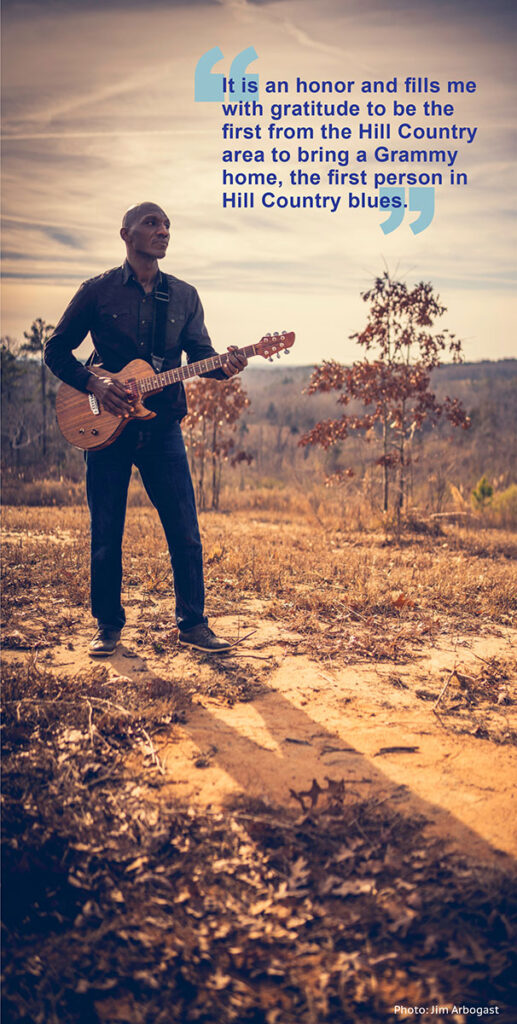
“It is an honor and fills me with gratitude to be the first from the Hill Country area to bring a Grammy home, the first person in Hill Country blues. All the legends that I played with — all the legends that should’ve won a Grammy or several — didn’t win one. So, I won that Grammy not just for myself, but for them and this region. I thank the Lord, and I’m just really humbled and grateful.”
Burnside says he has new songs ready to be recorded.
“But there’s no telling what the future may bring,” he adds. “I’m going to keep writing music. I feel like the universe throws you something to write about every day. So, I want to keep on putting good vibes out there with music, make people feel good and get them to the Hill Country!”